
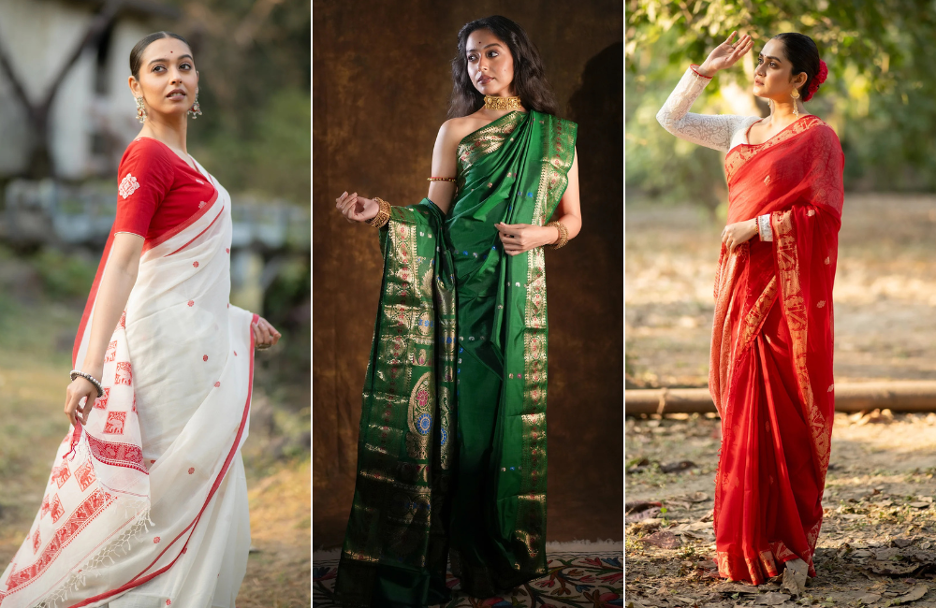
Once you hold a Baluchari saree, you immediately know there’s something different about it. The weight of the silk, the storytelling in the pallu, the sheer details of the motifs—it doesn’t feel like something made quickly. And that’s because it isn’t.
Handloom Baluchari sarees are among India’s most recognised handwoven textiles, originating from the Baluchar village in Murshidabad, West Bengal. But what truly sets them apart isn’t just how they look.
Understanding the process of making Baluchari sarees online gives you a much deeper appreciation for why they carry the price tag and prestige.
It Starts With the Silk
At the heart of an authentic Baluchari silk saree online lies the exquisite mulberry silk of Murshidabad. What truly sets this fabric apart is its unique structural secret: the yarn is spun with a significantly lower twist than standard silk.
This specific technique results in a textile that has a soft drape and a luxurious weight, offering a tactile richness that only few other silks can replicate.
The journey of this silk begins with sericulture. The silk yarn is carefully extracted from the silkworm cocoons, then smoothed out by boiling in hot water and soda. After that, the yarn is dyed using acid colour dyes, which gives Baluchari sarees their characteristic richness of tone.
After the dyeing process, the silk yarn is meticulously transferred onto the loom’s beams to prepare for weaving. This setup utilises two distinct types of beams: the smaller sisaban and the larger dhal. Once these are securely in place and the loom is fully tensioned, the intricate weaving process begins.
The Craft of Weaving
Baluchari sarees are handwoven. That alone tells you a lot about the time and skill involved! Originally, only pure silk threads were used. Over time, cotton has also been incorporated, though silk remains the preferred choice for traditional pieces. Today, there are brands like Katha: A Tale of Weaves that create stunning handloom Baluchari sarees online in both fabrics. Their sarees are not only crafted with heritage-inspired designs but also come with the Silk Mark certification, ensuring authenticity and quality.
The defining feature of a Baluchari saree is the pallu, where the design is arranged with great precision, maintaining cross-border and corner alignment in a clean box pattern. Getting this right requires not just skill, but patience and a trained eye.
Historically, these sarees were costly to produce and were mostly worn by women from zamindar families during special occasions. When you look at the craftsmanship, that context makes complete sense.
The Jala Technique: The Original Method
The weavers of Baluchar originally worked with what is called the Jala loom, or the Jala technique. A Jala is essentially a design reference, or a kind of template from which multiple design variations can be created. A well-made Jala can last close to 100 years!
Here’s how the process worked:
- To begin the process, the artisan meticulously drafts the design on paper before translating it onto fabric. This is achieved through a complex machan and thread system, which serves to create a precise master sample that guides the entire weaving sequence.
- A copy of the master sample is maintained on a secondary loom as a safeguard. This backup serves as a critical reference. If the primary Jala ever got damaged, the copy allows for its precise reconstruction without losing the intricate pattern.
One remarkable quality of Bengal Baluchari sarees made using the Jala technique was that they were reversible. The motifs were clearly visible and readable from either side of the fabric! The entire process of weaving one saree took 15-18 weeks, but the result was an extraordinary range of intricate, detailed patterns that are hard to replicate even today.
The Jacquard Technique: The Modern Approach
Somewhere during colonial rule, Baluchari sarees lost their popularity, and the art of making them was all but lost. Due to material and skill shortages, the techniques were lost, and weavers scattered to other parts of the country.
However, in the 20th century, artist Shubho Thakur played a key role in reviving Baluchari weaving. As part of this revival, the Jala technique was replaced with the jacquard technique, which is what most weavers use today.
In this modern approach, the design is first meticulously plotted onto graph paper before being translated into a series of punched cards. These cards are linked in a precise sequence and fed into a jacquard machine, which mechanically dictates the pattern, guiding every movement of the loom during the weaving process.
While the jacquard technique offers superior efficiency—reducing the weaving timeframe to 1-2 weeks, it involves certain compromises. It lacks the inherent flexibility of the traditional Jala, which somewhat limits the pattern’s complexity and diversity. Furthermore, a key difference of jacquard-woven sarees is that they are no longer reversible.
When you buy a Baluchari saree, you aren’t just buying fabric. You’re buying into a tradition of craftsmanship that has survived for centuries—through changing materials, techniques, and times.
Knowing how a Baluchari cotton saree is made helps you understand its value. And that, as any saree lover will tell you, makes wearing one feel even more special!
FAQs
1. What is special about Baluchari sarees?
Baluchari sarees are renowned for their exceptional storytelling artistry. They feature intricate depictions of mythological and courtly scenes woven into the fabric using extra weft silk.
Originating in West Bengal, these sarees showcase scenes from the Ramayana, Mahabharata, and historical court life, rendering each piece a unique narrative textile. The Swarnachari variation incorporates gold or silver threads, adding to the saree's luxurious appeal.
2. Where is Baluchari made?
Authentic Baluchari sarees are exclusively crafted in Bishnupur and its surrounding areas of West Bengal, making this region the sole hub for genuine production.
3. Is West Bengal famous for the Baluchari saree?
Yes, West Bengal is famous for the handloom Baluchari saree.