Something shifted in newsrooms in 2025.
Editors started noticing a pattern. Press releases that followed the same structure. Used the same phrases. Opened with the same kind of headline. Had quotes that sounded like nobody in particular said them.
The volume picked up. And the quality dropped.
By late 2025, research confirmed what editors already knew — nearly one in four press releases landing on major newswires was AI-generated. Not assisted by AI. Generated by it.
The media industry's response was swift and not particularly subtle. Press Gazette, one of the leading publications for journalists, published a guide specifically on how to spot an AI-generated press release. Editors started treating anything with the hallmarks of automated content — formulaic structure, generic language, suspiciously smooth sentences — as suspicious. And suspicious press releases get deleted.
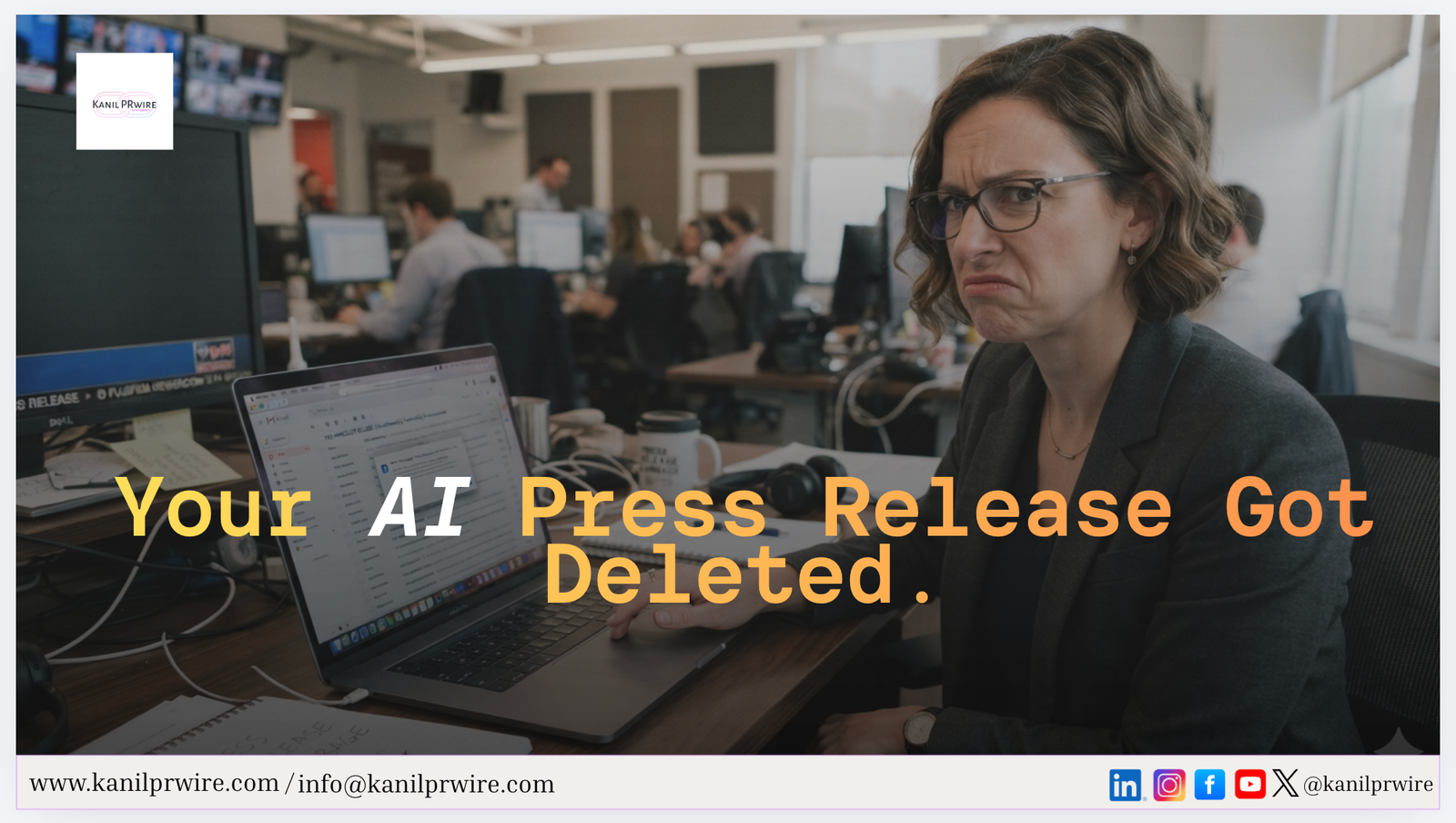
Not reviewed. Deleted.
What Editors Are Actually Looking For
To understand why AI press releases fail, it helps to understand what editors are actually doing when they open one.
They are not reading every word. They are scanning for signals.
Is the headline specific to actual news, or does it sound like a template? Does the first paragraph answer who, what, when, where, and why — or does it ease into the story with three sentences of context nobody asked for? Does the quote sound like a real person said it, or does it read like something a machine assembled from similar quotes it had seen before?
Editors develop this instinct quickly. When you process hundreds of press releases a week, you get very good at recognising the ones that were written by someone who actually cares about the story — and the ones that were generated in thirty seconds and sent without a second read.
The AI press releases fail the scan. And they fail it faster than any human-written release ever did — because they are uniformly competent and uniformly soulless. There is nothing wrong with the grammar. There is nothing right about the voice.
The Deeper Problem With AI-Generated PR
The grammar is not the issue.
AI can write grammatically correct press releases. It can follow the inverted pyramid. It can include a dateline and a boilerplate. It can even generate a quote.
But it cannot generate a genuine perspective. It cannot reproduce the specific way a founder thinks about the problem their company is solving. It cannot capture the particular insight that makes one press release feel like actual news and another feel like an announcement that could have come from any company in any industry.
That specificity — the thing that makes a press release feel like it came from a real organisation with a real point of view — is exactly what editors are scanning for. And it is exactly what AI consistently fails to produce.
The communications director of Google DeepMind — someone with access to the world's most advanced AI technology — has publicly stated that her team does not use AI to draft press releases or core communications content. The reasons she gave: nuance, strategic judgement, and brand voice protection.
If the team building the AI does not trust it with their own PR, that says something worth paying attention to.
What This Means for Brands
The brands that are getting media coverage right now are not the ones generating press releases faster.
They are the ones producing press releases that feel different from everything else in an editor's inbox.
Specific news. Real quotes from named individuals with actual perspectives. Headlines that state the news rather than describe an event. First paragraphs that respect the editor's time by leading with the most important information.
None of this is complicated. But none of it is something you can automate and trust without reading.
The press release that gets picked up is the one that reads like a human wrote it because they had something real to say — and took the time to say it clearly.
The Distribution Problem Makes It Worse
Here is something that compounds the issue.
A lot of brands using AI to write their press releases are also using low-quality distribution services that push content to hundreds of publications automatically — regardless of relevance, regardless of quality, regardless of whether the publication has any real audience.
The result is a press release that reads like it was written by nobody, sent to publications that are read by nobody, with a PDF report as the only proof it went anywhere.
This is not PR. It is the appearance of PR.
Real distribution means placing a well-written press release on publications that have actual editorial standards, actual audiences, and actual indexing — and verifying every placement with a live URL.
We covered what real press release distribution looks like at each step — and how to verify it actually happened — in detail here.
What Actually Works in 2026
AI as a starting point is not the problem. Using AI output as the final product is.
The brands getting consistent editorial pickup in 2026 are using a clear process. The announcement details go in. A draft comes out. A human reads it — someone who understands the brand's voice, knows what the actual news is, and can tell when a quote sounds real versus when it sounds generated. That human edits, refines, and makes decisions AI cannot make.
Then the press release gets distributed — not to every publication on an automated list, but to the publications that are actually relevant to the announcement. With live URLs confirming every placement.
That process is slower than letting AI write and auto-distribute. It is also the process that produces coverage an editor does not delete in three seconds.
The volume of AI-generated press releases in newsrooms is only going to increase.
Which means the ones that read like a human wrote them — with a specific voice, a real perspective, and genuine news value — are going to stand out more than they ever have.
That is not a reason to avoid AI entirely. It is a reason to make sure a human is in the room before anything gets sent.
If you want to talk about what well-written, properly distributed press releases look like for your brand, reach out on WhatsApp at +91-9759615049 or explore our publication network at pricing.kanilprwire.com.