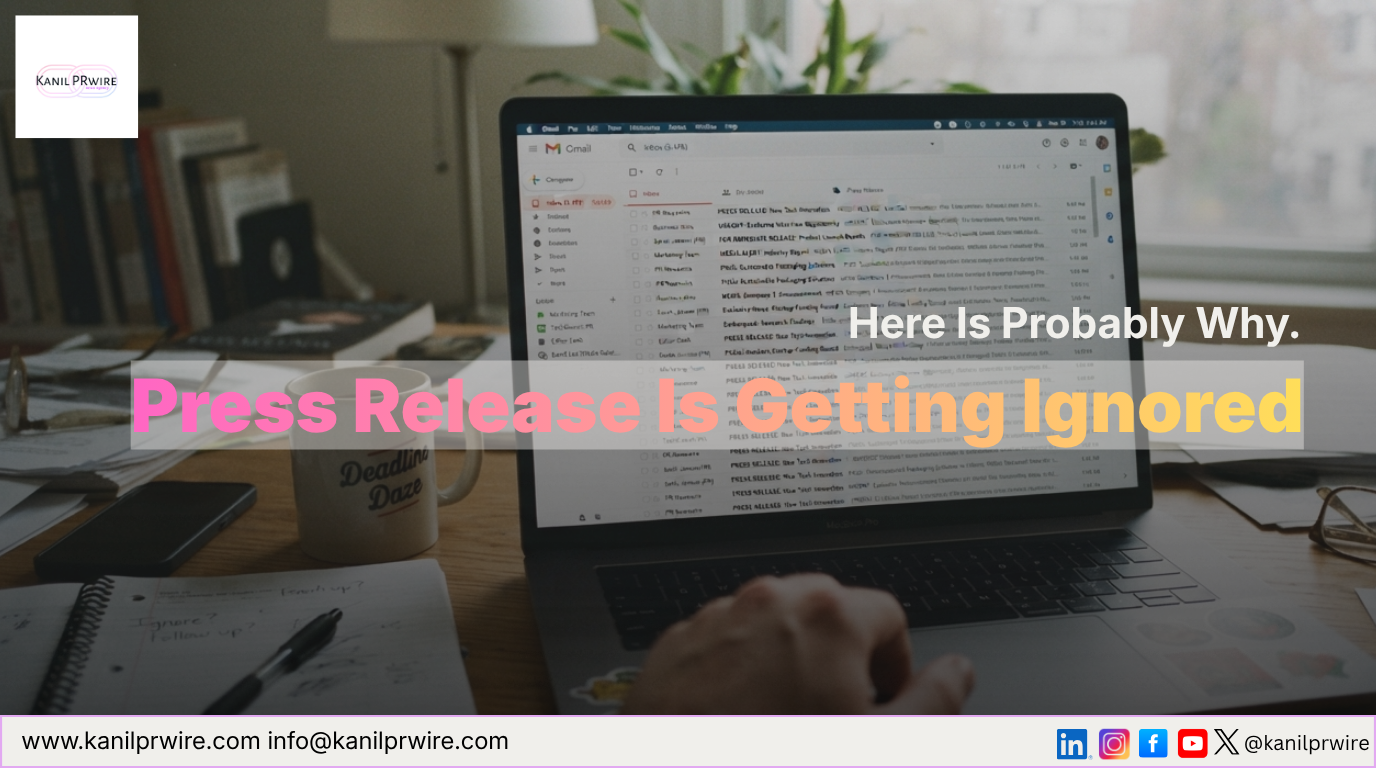
You spent time on it. Maybe you hired someone to write it. You sent it out — or paid someone to distribute it — and then waited.
And nothing happened.
No coverage. No journalist follow-ups. No spike in website traffic. Just silence.
This is one of the most frustrating experiences in PR. And it happens to a lot of brands — not because their news is not worth covering, but because something in the press release itself, or in how it was distributed, made it easy to ignore.
The good news is that most of these mistakes are fixable. Here is what actually causes press releases to get passed over — and what editors are looking for instead.
The Headline Does Not Say Anything
This is where most press releases die. Before an editor reads a single word of the body, they read the headline. And if the headline does not immediately communicate what happened and why it matters — the press release is already done.
The most common headline mistake is writing a description instead of a news statement.
"XYZ Brand Announces New Product Launch" is a description. It tells an editor that something happened but gives them no reason to care. Compare that to "XYZ Brand Launches AI Tool That Cuts Invoice Processing Time by 70% for SMEs" — that is a news statement. It tells the editor what happened, who it affects, and why it is significant.
Editors are moving through dozens or hundreds of press releases. A headline that makes them think "so what?" gets skipped. A headline that makes them think "interesting" gets read.
It Reads Like an Advertisement
Here is the thing editors notice immediately — and immediately distrust.
Words like "revolutionary," "game-changing," "industry-leading," "best-in-class," "we are thrilled to announce," "proud to share" — these are marketing phrases, not news language. The moment an editor sees them, they know the press release was written by a marketing team rather than someone who understands how journalism works.
A press release is not an advertisement. It is a news document. It should be written in third person, in active voice, with verifiable facts rather than superlatives. The goal is not to convince the editor that your product is amazing. The goal is to give them enough factual information to write a story themselves.
Replace "industry-leading solution" with what the solution actually does. Replace "we are excited" with a quote from a real person saying something worth quoting. Let the facts do the work.
The First Paragraph Buries the News
Editors cut from the bottom. That is a journalism convention that has not changed.
Which means if your most important information is in paragraph four — after the company background, the market context, and the founding story — most editors will never reach it. And even if they do, they will wonder why you made them work for it.
The first paragraph of a press release should answer five questions: who, what, when, where, and why it matters. All five. In two or three sentences. If someone reads only the first paragraph and nothing else, they should understand the full story.
Everything after the first paragraph is supporting detail — quotes, context, data, background. Important, but not the news itself.
There Is No Real News
This one is uncomfortable but worth saying directly.
Not everything is press release worthy. A new blog post is not news. A website redesign is not news. An internal promotion — unless it is a C-suite hire with a genuine market angle — is usually not news. A vague milestone like "we are excited to announce our next chapter" is definitely not news.
Genuine press release material includes product launches with specific details, funding announcements with numbers, meaningful partnerships, research findings with data, expansion into new markets, significant leadership appointments, and awards from credible organisations.
Before writing the press release, ask honestly — would a journalist covering this industry find this genuinely interesting? Would their readers care? If the answer is no, a press release is the wrong format. A blog post or a social media update might serve the same goal without needing editorial pickup.
The Distribution Was Not Actually Distribution
This is probably the most overlooked reason press releases fail to generate coverage.
Writing a good press release and sending it to five email addresses is not distribution. Uploading it to a single free press release website that nobody reads is not distribution. And receiving a PDF report that says your release was "sent to 500 journalists" without a single live URL to show for it is definitely not distribution.
Real distribution means your press release appears on actual publications — pages you can open, read, and verify. National news portals. Business media. Industry-specific platforms. Regional language publications that reach audiences in their own language. And for brands that need global reach, international wire services like GlobeNewswire, PRNewswire, ANI, and AccessNewsWire that place your announcement on platforms financial journalists and international media actually monitor.
The difference between a press release that generates coverage and one that disappears is almost always distribution. The writing matters. But if the writing never reaches the right platforms, none of it matters.
At Kanil PRwire, every press release we distribute goes across our network of 1,000+ publications — with live URLs confirming every placement. You see exactly where your press release appeared, and you can verify it yourself.
The Quote Says Nothing
Every press release has a quote. Most of those quotes are useless.
"We are excited to launch this product and look forward to serving our customers" — this is a quote that adds zero information. Any editor who wants to use it in a story has nothing to work with.
A good quote does one of two things. It adds a perspective that is not already in the body copy — the founder's view on why this matters for the industry, the CEO's take on what the market is missing, a specific insight that only the company can provide. Or it provides a human moment — something that makes the announcement feel real rather than corporate.
Think about it this way. If a journalist could remove your quote from the press release and nothing important would be lost — it needs to be rewritten.
What to Do Differently
None of this requires a large agency or a complicated process. It requires clarity about what news actually is, honesty about whether your announcement qualifies, and proper distribution that gets your press release onto platforms where editors and audiences will actually find it.
Write a headline that states the news, not just the event. Open with all five Ws. Use facts, not adjectives. Include a quote that actually says something. And distribute through a network that produces live, verifiable placements — not PDF reports.
If you want help with any part of this — writing, distribution, or figuring out which publications make sense for your announcement — reach out to us on WhatsApp at +91-9759615049 or explore our full publication network at pricing.kanilprwire.com.
A press release that follows these basics does not get ignored. It gets read. And sometimes — when the news is right and the distribution reaches the right people — it gets covered.
Kanil PRwire offers press release writing, distribution across 1,000+ publications, and international wire syndication through GlobeNewswire, PRNewswire, AccessNewsWire, and ANI. Visit kanilprwire.com or explore the full network at pricing.kanilprwire.com.