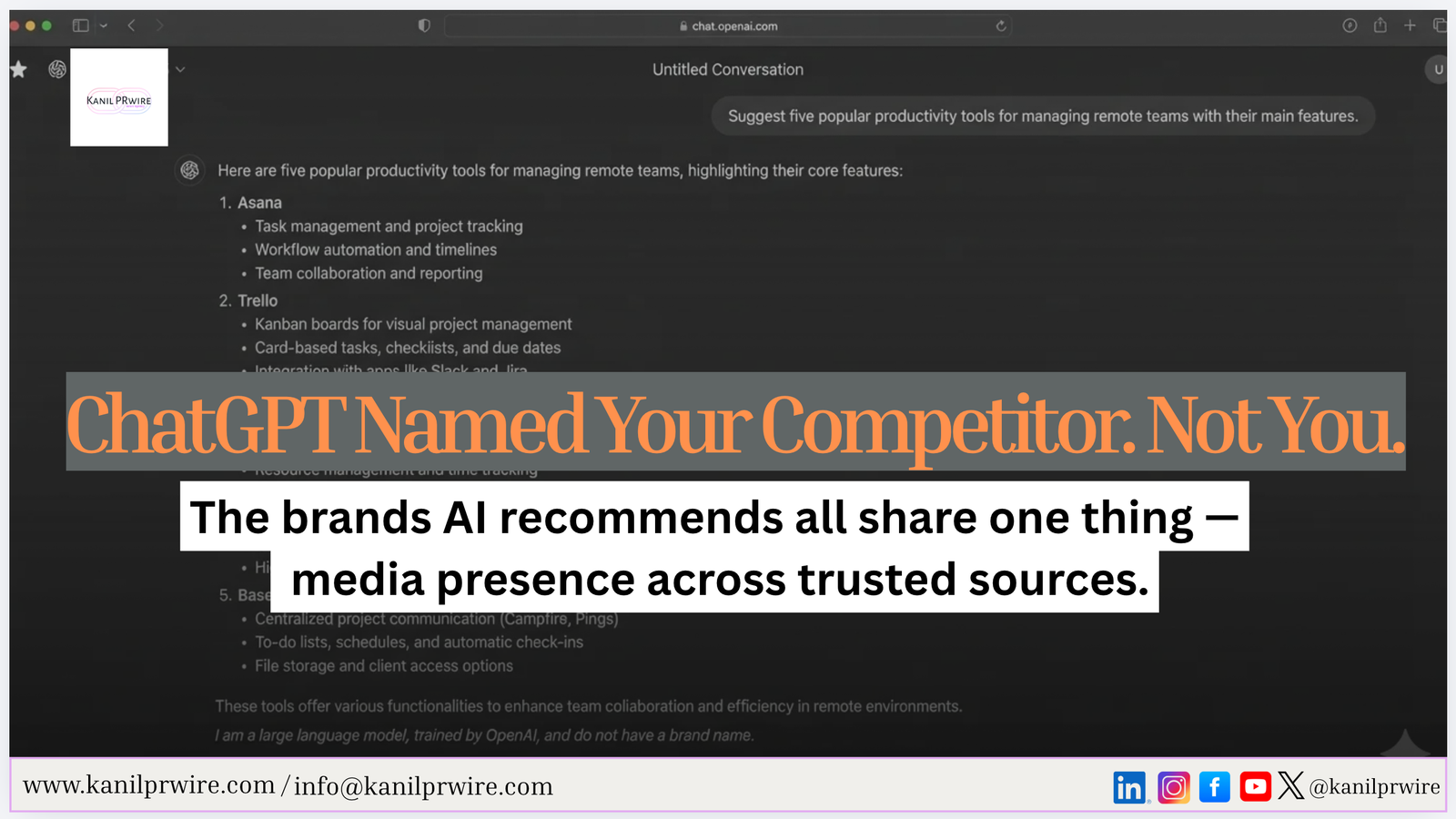
Ask ChatGPT to recommend a PR agency, a SaaS tool, a logistics provider, or a marketing service. It will name three to five brands with confidence — complete with feature breakdowns and use-case context.
Those brands are not the biggest companies in the space. They are not the best-funded. They are the ones the open web has talked about the most — in the right places, in the right way.
That distinction matters more than most brands realise, and it is changing how PR budgets should be allocated.
AI-Referred Traffic Now Converts at 4.4 Times the Rate of Traditional Search
ChatGPT is no longer a novelty tool. Founders, investors, procurement managers, and buyers are using it to shortlist vendors before they talk to sales. Daily AI search usage roughly doubled in 2025 — from 14% of searchers to over 29% by mid-year — and the trajectory is continuing upward in 2026.
The commercial stakes are real. Research shows AI-referred visitors convert at 4.4 times the rate of traditional organic search visitors. For B2B specifically, ChatGPT delivers a 56.3% higher close rate than leads from Google or Bing.
When a buyer asks ChatGPT for a vendor recommendation and your brand does not appear in the response — that buyer may never reach your website. They act on what they receive.
What ChatGPT Actually Uses to Decide Who to Recommend
ChatGPT does not rank websites the way Google does. It does not crawl pages in real time and return a list. It synthesises an answer from two sources — the training data it absorbed before its knowledge cutoff, and live web retrieval when it searches for current information.
Both sources share a common dependency: third-party coverage on authoritative platforms.
A brand that appears frequently across industry publications, news portals, editorial websites, and wire services builds what AI researchers call entity authority — the model's internal confidence that this brand is a legitimate, recognised player in its space. Brands with strong entity authority surface in responses. Brands without it do not.
One mention in a credible industry publication does more for ChatGPT visibility than fifty self-published blog posts. The model has learned to weight editorial, third-party coverage over owned content — because owned content is what every brand produces about itself, and it carries no independent signal.
Press Releases and Media Coverage Are Now Training Data
This is the connection most brands have not made yet.
When a press release is distributed across national news portals, business media, and wire services like GlobeNewswire, PRNewswire, and ANI — those placements become part of the open web's permanent record. They get indexed. They get cited. They appear in the data that AI models train on and retrieve from.
A brand that has distributed press releases consistently across credible platforms over the past two to three years has built a body of third-party documentation that AI systems can draw from when constructing a recommendation. That documentation signals — across multiple independent sources — that this brand exists, is active, and is recognised by platforms with editorial standards.
A brand that has never distributed a press release, never appeared in a business portal, and has no presence outside its own website is functionally invisible to AI systems — regardless of how good the product is.
The brands ChatGPT recommends all have one thing in common: a wide, distributed, third-party media presence built over time. Not ad spend. Not social followers. Editorial coverage on platforms AI systems trust.
The Window Is Still Open — But Narrowing
Research published in early 2026 found that brands establishing AI search presence now will hold a three-to-five times citation advantage over competitors who enter in 2027. The gap compounds because of how AI models learn: brands that are cited frequently across trusted sources become more visible, which leads to more citations, which reinforces visibility.
The brands that dominate ChatGPT recommendations in your industry two years from now are building that presence today. Most of them are not doing anything dramatically different from standard PR — they are distributing press releases, getting guest posts published, appearing in industry media. They are just doing it consistently enough that AI systems are building associations between their brand name and their category.
Brands that wait are not standing still. They are falling behind relative to competitors who are not waiting.
What This Means for PR Strategy
The implication is straightforward: PR is no longer just about reaching human readers. It is about building the kind of third-party presence that AI systems use to decide who to recommend.
Press release distribution across credible national portals, business media, and international wire services creates exactly the type of authoritative, third-party documentation that matters for AI visibility. Guest posts on industry publications add topical depth — associating the brand with specific use cases, problems, and categories in editorial content. Branded content placed across relevant platforms extends the footprint further.
At Kanil PRwire, our network covers 1,000+ publications across national English portals, regional language platforms, business and finance media, industry-specific sites, and international wire services including GlobeNewswire, PRNewswire, ANI, and AccessNewsWire.
Every placement creates a live, indexed, third-party citation — the kind that feeds directly into the visibility signals AI systems use.
The full publication list is at kanilprwire.com. If you want to discuss what building AI-visible PR presence looks like for your brand, reach out on WhatsApp at +91-9759615049.
ChatGPT named three brands in your category just now.
Yours was not one of them.
That is fixable. But not by waiting.