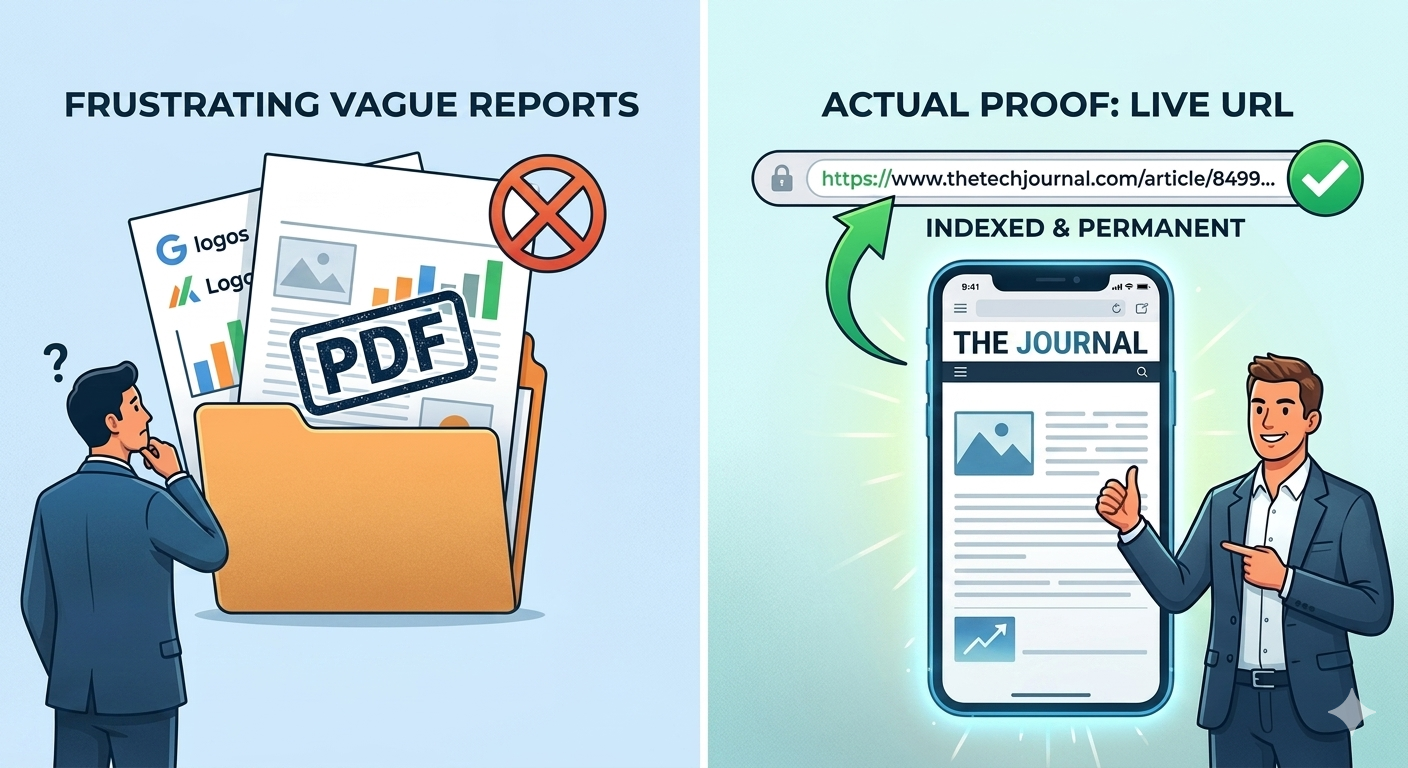
You paid for a press release. Your PR agency sent you a report. The report says your story was "distributed to over 400 outlets." It looks impressive. There are logos of news sites. There are numbers. There is a PDF.
But there is not a single link you can actually click.
This is one of the most common frustrations brands face when working with PR agencies — and most of them do not even realize they are being shortchanged until it is too late.
In this post, we are going to break down exactly why a live URL is the only real proof of press release placement, what agencies do instead to make their reports look legitimate, and the questions you need to ask before handing over your money.
What "Proof of Placement" Actually Means
When a PR agency distributes your press release or secures a guest post on a media platform, the end goal is simple: your content should be live and accessible on a real website, indexed by Google, readable by actual people.
Proof of placement, therefore, means one thing — a working URL that anyone can open in a browser right now and see your published story.
That is it. Nothing more, nothing less.
A live URL tells you:
- The publication actually ran your story
- The content is indexed and potentially appearing in search
- The placement is permanent (or as permanent as the site allows)
- You can share it, cite it, and use it in your marketing
Without a live URL, everything else is just a promise on paper.
What Most PR Agencies Provide Instead (And Why It Is Not Enough)
Here is the uncomfortable reality. Many PR agencies — especially those offering low-cost packages — do not provide live URLs because they cannot. And rather than being upfront about it, they substitute real proof with things that look like proof but are not.
1. Distribution Reports Without Links
Some wire services and PR platforms will send you a report showing how many "outlets" your press release was sent to. The key word here is sent to — not published on. Sending a press release to 500 news aggregators does not mean 500 sites published your story. Most of them are automated feeds that may or may not display your content, and even if they do, it is often only visible for 24-48 hours.
2. Screenshots
Screenshots are worse than useless as proof of placement. A screenshot can be fabricated in under ten minutes. Even a genuine screenshot can show content that was later removed, content behind a paywall, or content on a low-quality scraper site that nobody reads. A screenshot tells you nothing about whether the placement is still live, indexed, or valuable.
3. Reach and Impression Numbers
"Your press release reached 2.4 million people." This number sounds incredible. But how was it calculated? Usually, it is an estimated combined audience of all the outlets the release was sent to — not the outlets where it actually appeared. It is like saying your flyer reached everyone who lives near the post office.
4. PDF Reports With Site Logos
Some agencies send elaborate PDF reports featuring the logos of Forbes, Bloomberg, Reuters, and other major outlets. What they fail to mention is that your story appeared on a completely different, low-traffic site — and the logos are just there to make the report look impressive.
None of these are acceptable substitutes for a real, working, clickable link.
Why Some Agencies Cannot Provide Live URLs
It is worth understanding why this problem exists before blaming every agency in the industry.
Aggregator-heavy distribution: Many cheap press release services distribute your content to hundreds of news aggregators — automated platforms that pull in RSS feeds and display press releases temporarily. These are not real editorial placements. The content often disappears after a few days and was never reviewed by a human editor.
Lack of direct media relationships: Real media placements — the kind that stick around and carry SEO value — require either direct relationships with editors or access to established wire services like GlobeNewswire or PR Newswire. Agencies without these relationships cannot guarantee genuine placements and therefore cannot provide genuine URLs.
Volume-based business models: Some PR businesses operate on extremely high volume with extremely low margins. Individual client verification is simply not built into their process. They send, they report, they move on.
Scraper sites: A significant number of press releases do end up on indexed URLs — but on low-quality scraper websites with no real readership, no editorial standards, and minimal SEO value. An agency might technically provide URLs in this case, but they are not URLs worth having.
What a Real Live URL Proves — and Why It Matters Beyond Just Verification
A live, working URL from a credible publication does much more than just prove your money was well spent. Here is what it actually unlocks for your brand:
SEO Value When your content appears on a site with a high domain authority and links back to your website, it contributes to your overall search rankings. This is the entire foundation of press release SEO and guest post strategy. Without a live URL, there is zero SEO benefit — nothing for Google to index, nothing to pass link equity.
Shareable Brand Asset A live URL becomes a permanent piece of your brand's media portfolio. You can add it to your website's "As Seen In" section, include it in investor decks, share it with potential clients, and use it in sales conversations to build immediate credibility.
Long-Term Discoverability A well-placed press release on a credible platform can continue driving traffic for months or even years after publication. People searching for your brand, your product category, or the topic you covered may find it organically. This is impossible without a live, indexed URL.
Accountability Between You and Your Agency A live URL creates a clear, verifiable standard of accountability. Either the link works or it does not. Either the story is published or it is not. There is no room for ambiguity, inflated numbers, or vague language. This protects you as a client and also protects honest agencies from being compared unfairly to those who offer nothing but empty reports.
The Questions You Should Ask Before Hiring a PR Agency
Before you sign up with any PR agency or distribution service, ask these questions directly:
1. Do you provide a live URL for every placement? The answer should be an unqualified yes. If the agency hedges — "we provide distribution reports" or "we track reach across outlets" — that is a red flag.
2. How long does the placement stay live? Some placements are temporary. Ask whether the content remains on the publication permanently or gets removed after a period of time.
3. Can I see examples of recent placements for other clients? Any agency confident in their work should be able to show you real examples — actual live URLs from recent campaigns.
4. What sites specifically will my press release appear on? Vague answers like "major news outlets" or "a network of over 400 platforms" are not acceptable. Ask for a specific list or at least a representative sample of the types of sites involved.
5. What happens if a placement falls through? Even the best agencies occasionally face situations where a confirmed placement does not go live. Ask what their policy is in that scenario — do they replace the placement, offer a refund, or simply move on?
The Standard Every PR Client Deserves
The PR industry has a transparency problem. It has existed for years, and it continues because many clients — especially those new to PR — do not know what to ask for.
But the standard is actually not complicated. If you paid for a press release placement or a guest post, you deserve to receive:
- A working URL to the live, published content
- The name of the publication where it appeared
- The date it went live
- Confirmation that it is indexed and accessible
That is the baseline. Anything less than this is not proof — it is paperwork.
When you work with an agency that delivers live URLs for every single placement, you are not just getting verification. You are getting accountability, SEO value, brand assets, and the confidence that your investment actually went somewhere real.
Final Thoughts
The next time a PR agency sends you a 12-page report full of logos and impression numbers but not a single clickable link, you now know exactly what that means — and exactly what to do about it.
Ask for the URL. If they cannot provide one, that tells you everything you need to know.
Real PR leaves a real trail. A live URL is that trail.
Kanil PRwire delivers a verified live URL for every press release and guest post placement — no screenshots, no vague reports. Explore our services to see how transparent PR distribution works.