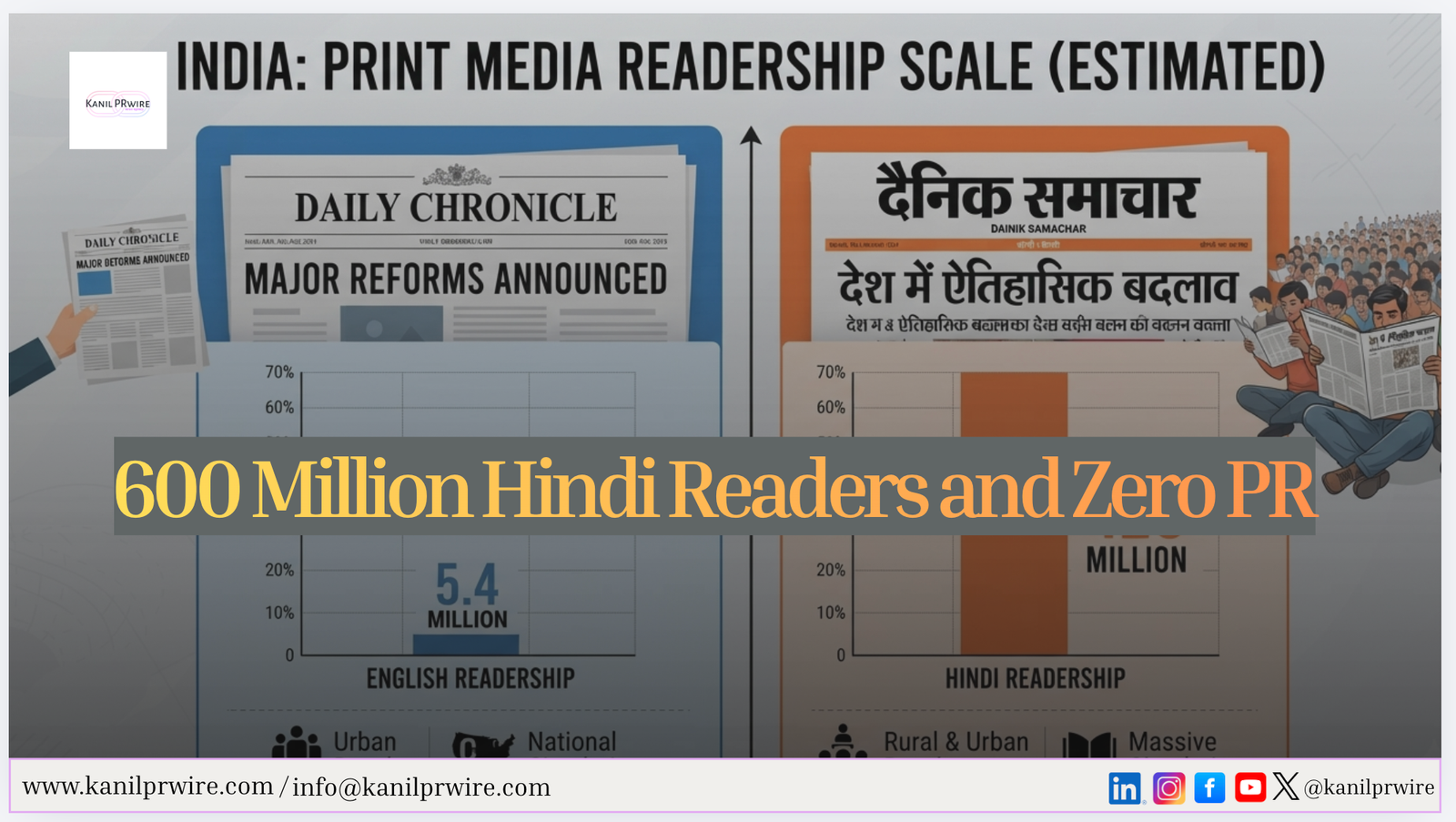
Dainik Jagran has 68 million readers.
Dainik Bhaskar has 57 million.
Amar Ujala reaches 46 million.
Combined, the top three Hindi publications alone reach more people than the entire readership of every major English newspaper in India — combined.
The Hindi internet in India is not a secondary market. It passed the English internet in total users years ago and the gap has been widening ever since. Over 600 million Indians consume digital content in Hindi and other regional languages. Regional digital publications are growing at three times the rate of their English counterparts.
And most brands doing PR have zero presence there.
The Audience Nobody Is Competing For
The English media market in India is crowded. Every brand with a PR budget is chasing the same national portals, pitching the same editors, competing for the same placement on platforms that reach the same audience — urban, English-speaking, metro-based.
That audience is real. It matters. But it is a fraction of India.
India has over 140 million readers who never pick up an English newspaper. They read Dainik Bhaskar, Amar Ujala, Eenadu, and Lokmat. They trust those sources more than any national English outlet. And in Tier 2 and Tier 3 cities — where India's next generation of consumers is concentrated — regional language media is not an alternative to English media. It is the only media that reaches them at all.
Regional-language creatives now outperform Hindi and English by 3.2 times ROI in Tier 2 cities.
The brands competing for that audience right now are not the ones with the biggest PR budgets. They are the ones that made a decision to show up where English-only brands structurally cannot.
What the Regional Media Landscape Actually Covers
Hindi is the largest segment — but India's regional media ecosystem extends well beyond it.
Tamil media reaches one of India's most economically active markets. Telugu publications cover Andhra Pradesh and Telangana, two states with significant consumer and business activity. Marathi media reaches Maharashtra — the state with India's largest GDP. Bengali, Gujarati, Kannada, Malayalam, Punjabi — each language has an established digital publication network with engaged, loyal readers who trust local-language content more than English alternatives.
Over 65 percent of India's digital news consumption happens in non-English languages.
A press release that only goes to English publications reaches 35 percent of the country's digital news audience at best. The other 65 percent — the majority — remains untouched.
The Credibility Difference
English media coverage signals credibility to investors and corporate audiences.
Regional media coverage signals something different — and in many contexts, more powerful. It signals that a brand is genuinely relevant to a specific community, geography, or language group. Not as a national announcement that happens to mention a regional market. As a brand that is actually present where that audience lives.
A reader in Kochi trusts Malayalam. A consumer in Indore connects with Hindi. A buyer in Coimbatore engages with Tamil. A press release published in the language a reader trusts most, on a platform they read every day, carries a different weight than the same announcement translated and pushed to a platform they have never heard of.
That trust gap is not something advertising can bridge. It is built through consistent presence in the publications people actually read.
The First-Mover Reality
Brands that develop regional PR strategies in 2026 will have a first-mover advantage that is extremely difficult to replicate.
Most brands have not started. The regional media landscape is largely uncontested from a PR perspective — especially in digital regional publications, which carry strong indexing, growing audiences, and far less competition for placement than national English portals.
The window to build a media presence in regional language publications before competitors do is open right now. It will not stay open indefinitely.
At Kanil PRwire, regional language distribution is part of our core network — Hindi, Tamil, Telugu, Bengali, Marathi and more — alongside national English portals and international wire services. The full publication list is at kanilprwire.com.
600 million people are reading news in languages your PR has never reached.
That is the market.